Showing posts with label JUNE. Show all posts

Saturday, July 31, 2010

Today in History - Britannic Hawaii

Rear Admiral Richard Thomas
On February 25, 1843, the Kingdom of Hawaii was unofficially annexed by British Captain Lord George Paulet of the HMS Carysfort.

Following several unfortunate disputes between the Hawaiian government and the British Consul, Richard Charlton, Captain Paulet cited "alleged insults and malpractices against British subjects" as his justification for his actions.  Both the French Consul and the commander of the U.S. East India Squadron, Commodore Lawrence Kearny, aboard his flagship the USS Constellation, also issued formal protests regarding Paulet's decision.

After five months of British rule under a temporary commission Rear Admiral Richard Thomas sailed into Hawaii aboard his flagship the HMS Dublin to settle the issue on behalf of the Queen.  Immediately upon arriving in port, Thomas requested to see Hawaii's King Kamehameha III.  This resulted in an apology and a promise to restore the kingdom at once with the condition of
The protection of rights and privileges of British subjects in Hawaii and [the guarantee of]  perfect equality with other favored foreigners.
On the morning of July 31, 1843, as the population began to gather at Kulaokahua, a plot of land at the foot of Punchbowl in central Honolulu, a downpour threatened to sour the events planned for Hawaii's restoration.  But according to accounts of the day, at 9am the sky cleared and several companies of Royal Sailors and Marines lined up facing the sea, awaiting the arrival of Admiral Thomas and the king.  Upon their arrival, an artillery unit fired a 21-gun salute.  As the British flag lowered and the Hawaiian flag was raised, British and American warships, merchantmen and whalers fired salvos in honor of the occasion.

In the afternoon, Kawaihao church held a thanksgiving service whereby King Kamehameha III declared that the life of the land had been restored.  He stated, "Ua Mau ke Ea o ka Aina I ka Pono" or "The life of the land is perpetuated in righteousness."  The phrase eventually became the motto for the State of Hawaii.

In 1850 the area where the ceremony occurred was renamed Thomas Square and became the first public park in Hawaii.  Aerial photos of the square reveal that it is designed in the shape of a Union Jack.

Courtesy of Google Earth

Wednesday, July 28, 2010

FDR Visits Hawaii


America’s 32nd Chief Executive made two trips to Honolulu in his unprecedented 12 years as President of the United States. Interestingly, the trips occurred 10 years apart almost to the day.

USS Houston arrives in Honolulu
On July 24, 1934, Franklin Delano Roosevelt became the first sitting president to visit Hawaii. He spent the day fishing aboard the cruiser USS Houston, off the the coast of Kailua-Kona. The Houston pulled into Hilo Harbor on the 25th and visited many Big Island sites before sailing the next day for Oahu. On the morning of the 26th, he arrived at Pier 2 in Honolulu where he was greeted by more than 60,000 people. Forming the letters “F R” in the sky, 100 Army and Navy aircraft also greeted the man from Hyde Park. As he walked down the gangway with his sons at 9:15 am, the battery at Ft. Armstrong fired a 21 gun salute in his honor while the Marine band played the National Anthem. A few moments later, the president engaged in a whirlwind tour of the island of Oahu.

The presidential entourage circled the city of Honolulu before heading north on the Pali road toward Oahu’s scenic North Shore. At Schofield Barracks, Roosevelt witnessed a 15,000 troop military review, the largest ever staged in Hawaii at that time. Later that evening, he dined with Governor Poindexter at Washington Place. The next day, he visited Pearl Harbor and dedicated the new gate on the Waikiki side of Ala Moana Park. Eventually, the gate would be named Roosevelt Gate. While in Honolulu the president stayed at the Royal Hawaiian Hotel where he attended a luau. Olympic swimmer, Duke Kahanamoku, taught his sons to surf. He also spent an hour privately conversing with Harvard classmate, Walter Dillingham, at the magnate’s home, La Pietra, located near Diamond Head.

Constantly referred to as “F.R.” in the local paper, not the “F.D.R.” that many have grown accustomed, Roosevelt planted a small kukui tree outside of the Iolani Palace on the 28th before offering farewell remarks and departing the islands at a little before noon.

Radford Mobley of the Honolulu Star Bulletin wrote that the President came to Hawaii,

For more than a mere fishing expedition...Concerning Hawaii as the American outpost of the Pacific, the president is anxious to confer with the heads of the military units first hand to determine for himself the defense needs here. His visit may later lead to an increase in the size of the army and navy posts…As the time approaches for the release of the Philippines, the president desires full preparedness information regarding this bulwark in the Pacific.

By the summer of 1944, much of Mr. Mobley’s insight proved prescient.

MacArthur, Roosevelt and Nimitz
F.D.R. spent well over 10 years in the Oval Office by July 26,1944. Still commander-in-chief when Hawaii, the “bulwark in the Pacific” was “suddenly and deliberately attacked by naval and air forces of the Empire of Japan,” Roosevelt spent the last three years leading the United States from that crippling defeat to repeated victories in Europe and in the Pacific. Now on this July 26th aboard a different cruiser, the U.S.S. Baltimore, he arrived to the fabled port in Hawaii that had become synonymous with the Alamo. There at Pearl Harbor he met with his two Pacific commanders Admiral Chester Nimitz and General Douglas MacArthur.

Holmes Mansion
Although the three American leaders met briefly onboard the Baltimore, the real discussion transpired at the Waikiki home of a wealthy businessman, Christian Holmes. As in 1934, the president spent a few days touring various areas, mostly military, of Oahu. However, on the evening of the 27th he sat down in front of a large map of the Pacific in the Holmes’s mansion to discuss the way forward in Pacific operations with MacArthur, Nimitz and Chief of Staff Admiral Leahy.

Most historians probably agree that the Honolulu Conference, as it is sometimes called, served several purposes beyond simple military planning. To the president, it was an opportunity to show the country during an election year that he possessed the stamina to remain commander-in-chief for another four years at a time when his health was increasingly under scrutiny. It was also an opportunity to make an appearance with General MacArthur, the sometimes outspoken critic of the president’s policies, who purported to be a potential Republican opponent in the future. While in Honolulu, MacArthur pressured Roosevelt into accepting his plan to liberate the Philippines and thereby fulfill his promise to return to that island nation following defeat at the hands of the Japanese in 1942. He argued that the nation’s honor as well as the president’s political future was at stake.

Honolulu Conference

On the 28th F.D.R. made his decision known to proceed with General MacArthur’s plan through the Philippines, while Admiral Nimitz forces continued their thrust toward the Japanese home islands via the Central Pacific. It is unclear whether the president’s decision was purely politically motivated, but it certainly didn’t hurt his election chances when the revered general heaped praises on the president’s firm control and grasp of wartime strategy.

As the U.S.S. Baltimore pulled away from the Hawaiian Islands later that day, the charismatic leader flashed his famous smile, concealing the reality of his failing health which prevented him from witnessing the fruits of that strategy. Within nine months the president would pass into eternity.

On the grounds of the Iolani Palace stands a tall kukui tree and a plaque that reads,
President Franklin D. Roosevelt
Planted This Kukui Tree
July 28, 1934
The tree stands as testament to the passage of time and of the momentous events that occurred in the decade between 1934 and 1944 when the Hawaiian Islands took center stage in the world’s history.

Friday, July 23, 2010

Today in History - The USS Nautilus

On July 23, 1958 the USS Nautilus SSN-571, the first nuclear powered submarine departed Pearl Harbor for a historic journey to the North Pole known as "Operation Sunshine". 

The Nautilus and her 116 crewmembers would arrive at 90 degrees north 11 days later on the evening of August 3.  Upon reaching the pole Commanding Officer, Commander William Anderson, would utter the words, "For the world, our country, and the Navy - the North Pole."  This milestone saw the Nautilus traverse under 1,830 miles of polar ice for a total of 96 hours.

The Nautilus is now a museum in Groton, Connecticut.

The USS Nautilus prepares to depart
Pearl Harbor for Operation Sunshine

Friday, June 25, 2010

The First Submarines Arrive at Pearl Harbor

Today's date marks the ninety-first anniversary of the arrival of the first submarine division in Pearl Harbor.  Submarine Division Fourteen, consisting of six R-boats numbering R-15 through R-20, arrived in Pearl Harbor on June 25, 1919 and served in Hawaii for the next eleven years.
State of the art for their time, the Navy built R-class boats as the First World War came to an end.  The subs weighed in at about 600 tons, measured at 186 feet in length, and carried a crew of only twenty-nine Sailors.  The R-18 made history at the fledgling base as the first submarine to moor at Pier 1, located at Pearl Harbor’s Quarry Point.  The other five boats anchored at nearby Kuahua Island, along with the division’s tender, the USS Beaver, until more improvements occurred at the piers.  Kuahua functioned as a temporary submarine facility until February of 1920.  The construction of facilities at Quarry Point lacked funding at the time that the new submarines arrived.  As a result, the crews of the R-boats were forced to find shelter in tents provided by the Beaver.  Once described as a “swamp and cactus covered wasteland,” Quarry Point posed a challenge for the submariners to establish a livable environment.  They cleared the land and installed temporary facilities shipped over from  France following America’s withdrawal from Europe at the end of World War I. 
Lieutenant Commander Felix X. Gygax, a man with an unforgettable name and a distinguished career as a pioneer in the submarine business, was the first commanding officer of this small contingent.  He holds the distinction of the first Officer in Charge of the Submarine School in new London, Connecticut.  However, it was his replacement who eventually rose to naval legend. 
On July 17, 1920, the Executive Officer on board the battleship USS South Carolina relieved Commander Gygax as Commander of Submarine Division Fourteen, of the new division tender USS Chicago, and of the Submarine Base.  His name was Commander Chester W. Nimitz.  Despite the economic restraints placed on much of the military’s operations in the years following the war, Nimitz was largely credited with providing the base with its earliest infrastructure using surplus equipment left over from the wartime expansion.  The first permanent structure was built on Pearl Harbor sub base in 1923.  Nimitz left Pearl Harbor in 1922 for the Naval War College, unaware of the historic circumstances that would necessitate his return twenty years later.  
The submarine base at Pearl Harbor experienced many changes through the years.  The base remained inadequately funded until the 1930s drew to a close and the United States slowly awakened to the “gathering storm” in Europe.  Following America’s entry into World War II, hundreds of workers funneled through the base and dozens of temporary structures required wholesale changes to the geography of the base.  Inevitably, it became a vital center of undersea operations in the Pacific.
But what of the old R-boats, the first tenants of Quarry Point?
Surprisingly, all of the subs served through World War II as training vessels and most transferred to the U.K. under the Lend-Lease program.  Eventually, the Navy scrapped them.  
Tragically, the R-19, later redesignated SS-96, sunk when the Canadian vessel HMCS Georgian rammed the submarine on June 21, 1942 in the western Atlantic.  All hands were lost.

Sunday, June 6, 2010

Normandy

On the morning of June 6, 1944, a vast armada of Allied ships moved in close to the coast of Normandy and began an artillery barrage on German held coastal positions.  It marked the beginning of the long anticipated invasion of France that would free Europe from Nazi tyranny.
On station that morning off Utah Beach was the battleship USS Nevada.  Her main battery of ten 14” guns lobbed shell after shell on the German shore defenses.  Considering the difficult road she took to get there, what a sight it must have been to see this proud warship providing naval gunfire support on this historic day. 
The Nevada had been one of the eight battleships tied up in Pearl Harbor on the morning of December 7, 1941.  This battleship’s historic dash to the sea to escape the harbor was the “stuff of legends.”  Despite her spirited efforts, the attacking Japanese aircraft laid several bombs into her deck and she was forced to beach off Hospital Point.  Fifty brave crew members lost their lives.  However, this would not mark the end of the Nevada’s career.  In many ways, it was only the beginning. 
It is a great credit to all of the workers of the naval shipyard at Pearl Harbor who salvaged the Nevada, along with five of the other eight battleships that suffered various degrees of damage in the attack.  Only the USS Arizona and the USS Oklahoma were lost forever.
By the summer of 1943, the USS Nevada was back in action and contributing to the war, both in the Pacific and the Atlantic theaters.  Because of the perseverance and grit of those shipyard employees the Nevada and the other crippled battleships at Pearl Harbor found a new lease on life.  Though they quickly lost their place as the centerpiece of naval strategy, their roles in shore bombardment and anti-aircraft support proved vital in the long war.
On this 66th anniversary of D-Day we remember all of those who gave the ultimate sacrifice to free people they didn’t even know.  We also honor the fortitude and ingenuity of the American people who rose up to the challenge of war, against all odds.  
Nothing symbolizes this better than the resurrection of an old and battered battleship crossing an ocean to liberate the world.


Friday, June 4, 2010

Listen to the Gooney


"The realization of a dream come true" is how I would describe my feelings as I stepped off the plane on the Sand Island runway of the Midway Atoll.  The other thing I felt right away was the heat, but at the moment I really didn't care.

As a historian with a great deal of interest in World War II I have always wanted to visit the place where The United States’ fortunes turned in 1942. I was struck by how beautiful the atoll was. I have seen it in pictures but never up close and personal. As we flew the three hours that it took to reach the island from Honolulu, I also stared out at the endless stretch of ocean and couldn’t help but contemplate how amazing it was that this tiny atoll would be a scene of such monumental events. Standing on the airstrip at Sand Island, I thought, “this is where it all went down.”  I tried to imagine the Japanese aircraft flying in and the American planes lifting off to meet them. I squinted my eyes a bit and wondered if I could imagine the smoke rising from the attack and listened for the voices of the Marines and Sailors who fought back.

And then there were the island’s most prominent residents -- the Layson Albatross, more popularly known by the less dignified name Gooney Birds. I had heard that there are a lot of these birds on Midway, but I was not prepared to have to avoid them with almost every step. When asked if I had taken any pictures of the birds I would respond, “How can you take a picture without them? They are everywhere.”

The ceremony commem-orating the Battle of Midway went off without a hitch and I would like to commend the members of the Fish and Wildlife Service, Military Historical Tours and the Pacific Aviation Museum who co-sponsored the event. They all did an outstanding job of not only honoring those who fought the battle, but taking care of their visitors who had come to be a part of this once in a lifetime experience.
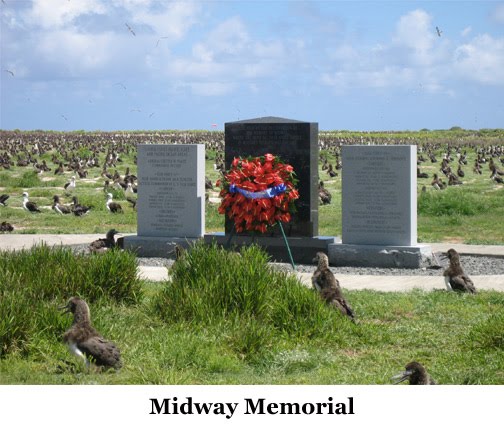
I was especially moved to see the veterans from both sides meeting here sixty-eight years later. They all watched the ceremony unfold and later shook hands as they visited the memorial that had been erected at the site years before.
Kaname Harada was a Zero pilot assigned to the Hiryu on June 4, 1942. In an interview later in the day, the 93 year old Harada mentioned how beautiful the atoll looked today. He said it looked the same way those sixty-eight years ago. It’s interesting that he would think of the beauty of the islands as he winged his way into combat. He was a gentle man who seemed more interested in preserving a lasting peace than in relishing in the bygone glories of war. This is often the case with those who have seen first-hand what war can do.

Marine Sgt Crook, stationed on Midway’s Eastern Island that morning and responsible for servicing the obsolete F2 Brewster Buffalos that were mauled by the Japanese Zeros, remembers events in much the same way. “I knew many of those pilots,” he recalled.  “None of them came back.”  “There were 10,000 Japanese out there and they were coming to take Midway. That’s all we knew. We didn’t have anymore airplanes…they were all gone. They told us to dig in and take as many out as you could because they were coming in….it was three or four days before we had any information on the outcome of the battle.”

He went on to say how familiar the islands looked after all these years. “The buildings I remember are all gone but everything else looks the same. The runway is still there but it is grown over…it was all a long time ago.”

As I stood on the North Beach of Sand Island, I looked out to the north west wishing I could somehow see hundreds of miles past the horizon, and almost seventy years in the past to see the great carriers of the Japanese Empire and the U.S. Pacific Fleet sailing toward their epic clash. It was sobering to realize that five of them were still out there resting at the bottom of the sea.

Which brings me back to Midway’s winged residents. They are the one thing that remains constant on this far away outpost. The Layson albatross come and go year after year, completely unaware of the gigantic struggles of man. As I watched them soaring gracefully through the air and sitting perched on every available scrap of real estate in the atoll I felt a sense of awe that events here really do carry on much as they always have. Things are quiet on Midway now, and there is very little left to remind anyone of its historic past, but seeing the birds in flight, soaring seemingly effortlessly on the Pacific breeze, reminded me that because of our victory in the Battle of Midway, we remain free.

You can learn a lot from a Gooney bird.

Midway


Today, we mark the 68th anniversary of the Battle of Midway. On June 4, 1942 the Imperial Japanese fleet bore down on the United States from several directions in an effort to draw out the carriers of the U.S. Pacific Fleet. If all went as planned within days, the Japanese would control the Midway Atoll and several islands in the Aleutian chain. These footholds would allow Japanese forces to harass the Hawaiian Islands and provide Japan with a security screen to all but close the North Pacific from American naval traffic.

From where we stood as a nation the situation was grim. Japan had overwhelmed the Allied forces in the Pacific since the surprise attack on Pearl Harbor on December 7, 1941. One after another the British, American, French and Dutch strongholds in the region were overrun and Japan’s forces seemed increasingly unstoppable.

Politically the President had a difficult problem. How to stop the Japanese offensive, while still committing the main focus of American forces in Europe to stop Nazi Germany from defeating England and the Soviet Union. After all, the United States had entered this war as a result of Imperial Japan’s attack on America and the American people wanted to see Japan defeated so how would Roosevelt justify assigning a secondary focus to the Pacific.

Japan hoped to cripple the United States once and for all and force a negotiated peace, allowing for Japan to reinforce their mastery of the Western Pacific unhindered by her Eastern Pacific rival. Admiral Yamamoto’s bold plan would marshal Japan’s naval forces in much the same way as the Pearl Harbor expedition six months prior. Though Japan would invade the Aleutian Islands and Midway, the real hope for Japan would be that the remaining American naval forces would come out to defend the atoll only 1,100 miles from the military facilities in and around Pearl Harbor. If things went as planned then the Japanese carriers would pounce on the precious few carriers of the American Pacific Fleet and effectively end America’s ability to defend the Pacific for the near future.

Admiral Chester Nimitz found himself in a difficult situation, how to meet the Japanese challenge, at the risk of losing the three precious carriers that stood between the Powerful Imperial Japanese Navy and the west Coast of the United States. Fortunately Admiral Nimitz at least had the element of surprise thanks to the brilliant intelligence work conducted by the Combat Intelligence Unit in Pearl Harbor which, following the breaking of the Japanese JN-25 code had ascertained, not only Japan’s planned assault on Midway, but also where and when to expect the attack. If the Admiral was correct he could send his three available carriers the Yorktown, Hornet and Enterprise on a sneak attack of their own and inflict a defeat on Japan. If his gamble failed, then the remainder of America’s offensive capabilities in the Pacific could be lost forever, furthering not only the war in the Pacific but perhaps jeopardizing America’s war effort as a whole.

On the that Summer morning of June 4, 1942 in a span of only about six minutes, three of the four Japanese carriers the Akagi, Kaga and Soryu would be set aflame and would eventually sink. The fourth carrier the Hiryu would launch her aircraft against the Yorktown in two attacks which would lead to the death of that great ship, but the Hiryu’s time would come as well when Dive-Bombers from the Enterprise and Yorktown would send her to the bottom. America had survived and Japan’s fortunes in the Pacific would soon turn.

Thanks to the ingenuity and aggressive “calculated risk” taken by Nimitz and his commanders both at sea and on the ground the United States won arguably its most decisive naval battle in history. The victory has been referred to as the turning point in the Pacific theater but an argument could certainly be made that its consequences were far broader. The destruction of a large portion of Japan’s naval air fleet and the experienced pilots who flew in it set the Japanese navy into a position of defense and America took an offensive stand that they never relinquished. America’s forces could be safely focused on the European theater while the Americans public had reason to believe that Japan’s defeat would be imminent.

Today on Sand Island of the Midway atoll a memorial marks the occasion of this epic battle which refers to June 4, 1942 as, “the day when the American spirit reached unparalleled heights, and in so doing, saved democracy for the Western World.”

Our gratitude remains